

Your creative brain doesn't care if it's ugly
CreativeRx: Creative Health is found in consistency, not performance; we're allowed to have fun (and dance!); the artistic philosophy that embraces imperfection rather than hide it.

CreativeRx is your dose of creative thinking in an exhausting, overwhelming world. Think of it like a peek into the brain of a Creative Health Scientist: the ideas I’m thinking about, data points I’m collecting, rabbit holes I’m exploring.

YOUR CREATIVITY IS ALLOWED TO BE…MEDIOCRE 🧠
One of the hardest things for me to accept as a Creative Health Scientist - and a recovering overachiever (will it ever end? 😅) - is learning that my creative brain literally does not care at all about what I make…as long as I’m doing it.
I know. It doesn’t matter how many times you hear it either; it may take years (a lifetime!) to finally sink in, but: The power of our Creative Health comes from consistency, not performance.
This tension point is probably the most insidious, and powerful, unlock in this entire field of work. And, it’s particularly true for those of us who have been trained - through school, work and daily life - that the quality of every single thing you make matters.
I’m writing about this topic this week, because I can bet that the majority of you have been reading the past few newsletters (which centered on analog, physical creative expression) and experienced at least one moment of imposter syndrome.
A ping of perfectionism. The sneaky, creeping suspicion that making things with your hands must be nice for some people - not me.
I’ve been there myself. Frankly, it’s exactly why I got into this work. But, it doesn’t matter if you’ve been a practicing artist for five decades or haven’t touched a paintbrush in years - after studying thousands of adult’s creative behaviors at Daydreamers, I have seen first-hand just how uniquely difficult it is for all of us to turn creativity into a regular habit.
Unlike other health practices where being “good” at them is just a bonus, by its very nature, creative expression forces us to do something different: We have to visibly look at the imperfect parts of ourselves that we usually keep hidden.

And, every single one of us tenses up when our inner world becomes…visible.
So, it’s natural to react by pushing our creativity to the margins. To let it fall to the bottom of our To Do list, or give an excuse that we’re “just not good” at it.
The thing is: Scientific research shows us, again and again, that our brains and bodies literally do not register how “skilled” we are at creating when it comes to our health. It doesn’t even matter if we feel inspired or confident or knowledgeable while we’re doing it.
What does register? Our engagement. Our presence. And most importantly, our capacity to show up, again and again.
In next week’s Deep Dive we’re going to explore this exact tension - the latest research on exactly how to build analog creative habits in our very online world, and why talent isn’t even part of the picture.
One takeaway I do want to preview for you is this: In one of my absolute favorite studies in this space, researchers looked at thousands of college student’s creative habits and tracked their emotions, motivation and flourishing for weeks.
They found something that we’ve replicated many times in our work at Daydreamers - and I now call The Creator’s Runner’s High: The biggest benefits of our creativity don’t show up immediately. They appear the next day (and they last 48+ hours!).
More energy, a better mood and this sense of vitality you can’t fully explain - these benefits of Creative Health doesn’t show up for the people who create a perfect painting once and forget about it for weeks.
They shows up for the people who made something - and kept creating. Those who move it from the margins of their life to the very center. Who see every instance of creative expression like a regular workout, not a performance: Imperfect, consistent and focused on the process.
So, this week - remember this: You don’t need to be extraordinary to be Creatively Healthy. In fact, that might be the very thing keeping you stuck.
From my view, our Creative Health is built in the reps. The imperfection. The ability to keep showing up, no matter what.
And, I’m grateful that we get to do that, every week, together.
From my brain to yours,
Katina, Creative Health Scientist & Daydreamers’ Co-founder + Chief Science Officer
Tell me what you think: Did this resonate? Comment below or hit reply - I read every response 🫶🏽
Next week’s Deep Dive 🤓: The Analog Creative Toolkit - Your Scientific, Actionable Guide to Offline Creative Health
→ We're breaking down the exact scientific formula behind turning your creative expression into a habit in a very online world. And, as a bonus - we’re going to break down the neuroscience behind how specific analog practices impact your well-being (drawing, cooking, gardening, building, etc.) Deep Dives subscribers will get the full toolkit + access to our next Discourse Club - an open studio to create, together.
ART SHOULD BE A HABIT, NOT A LUXURY 📢
“Too often, we let the humdrum reality of life get in the way of the arts, which can feel frivolous by comparison. But this is a mistake. The arts are the opposite of a diversion from reality; they might just be the most realistic glimpse we ever get into the nature and meaning of life. And if you make time for consuming and producing art—the same way you make time for work and exercise and family commitments—you’ll find your life getting fuller and happier.”
→ This piece came out in 2022, but it’s worth revisiting. Around the same time actually, I had the chance to chat with Arthur about what we were building at Daydreamers - and it was exciting to hear how much of a personal passion this is for him, too. While his work focuses more on the philosophical side of human flourishing, I think the overall framing is important: Art isn’t a luxury - it’s a habit, just like exercise and sleep. Even more, if we want to feel fully alive, we have to make time for it.
WE’RE ALSO ALLOWED TO HAVE FUN + JOY + CELEBRATION 🎉
“Most people, myself included, didn’t understand every word - but you can’t deny you felt something. You felt the joy. The power. The connection. And that’s exactly what art allows us to do. Scientifically, it bypasses our logic and connects directly with our emotion. We don’t need translation - everything he did transcends language.”
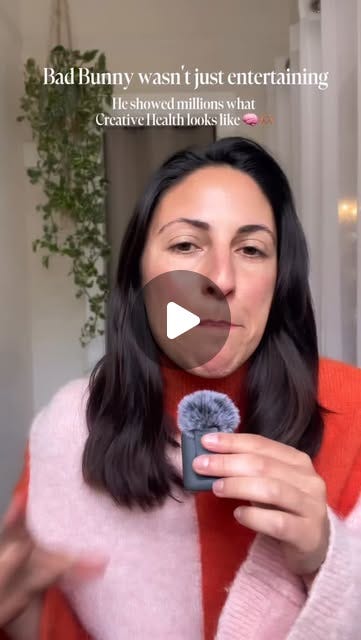
→ Bad Bunny’s performance at the Super Bowl last week wasn’t just fun - it was honestly a perfect display of what Creative Health unlocks, individually and collectively. I shared a few scientific reasons why on social. But overall: a collective creative experience like this - regardless of language - reminds us how rebellious, essential, and connecting play and joy can be. We need it more than we think 🙃
IMPERFECTION IS AN ARTISTIC PHILOSOPHY: WABI-SABI 🥣
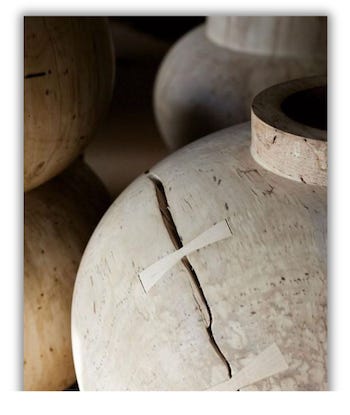
I’ve long been a fan of the Japanese philosophy of wabi-sabi - the idea of embracing and celebrating imperfection in creative work. But this week, I revisited it and got particularly curious about what makes it so compelling.
TLDR; Wabi-sabi dates back to 15th-century tea ceremony culture and is rooted in Zen Buddhism’s acceptance of change and imperfection. Back then, the most prized tea bowls weren’t symmetrical or smooth - they were intentionally irregular, rough, and usually uneven.
Even more, these “flaws” were considered the most beautiful part of the piece because they showed the real handwork of the maker, the passage of time and the reality of impermanence.
This practice still continues today: When pottery breaks, the Japanese art of kintsugi repairs it with gold lacquer - making the cracks more visible! I find this so beautiful: The breakage isn’t hidden; instead, it’s celebrated as part of the object’s history.
To me, this practice stands in direct opposition to our Western creative tendencies. Ones that prize perfection, symmetry and sensory monotony. Instead, wabi-sabi says to us: Perfection is cold and lifeless - imperfection is alive and human.
Practically, for your Creative Health your “mediocre creativity” isn’t a failure. It’s proof that you left evidence of your humanness in the world.

I so enjoyed this read!
"The thing is: Scientific research shows us, again and again, that our brains and bodies literally do not register how “skilled” we are at creating when it comes to our health. It doesn’t even matter if we feel inspired or confident or knowledgeable while we’re doing it."
I'm so curious to hear more about this claim. Are there any citations that you'd highly recommend I check out? I'm so sorry if I missed them as part of the article. I will read more about the Daydreamers study finding.
The concept of the "Creator's Runner's High" showing up 48 hours later really intrigues me - have you noticed any patterns in what types of creative activities produce the strongest delayed effects? I'm wondering if there's something about working with physical materials versus digital creation that changes how those benefits manifest.