
Existential anxiety or liminal space? How the creative unseen helps us transform
CreativeRx: Getting our tolerance back for liminal spaces, Dreamcore aesthetic and the science of the collective unconscious

CreativeRx is our weekly newsletter with a simple purpose: To expand the surface area of our Creative Brains. Every Sunday, we dissect one idea from a scientific POV - and then share the exact, high-quality creative inputs you can mull on all week.

LIMINAL SPACES ARE CREATIVITY’S BREEDING GROUND
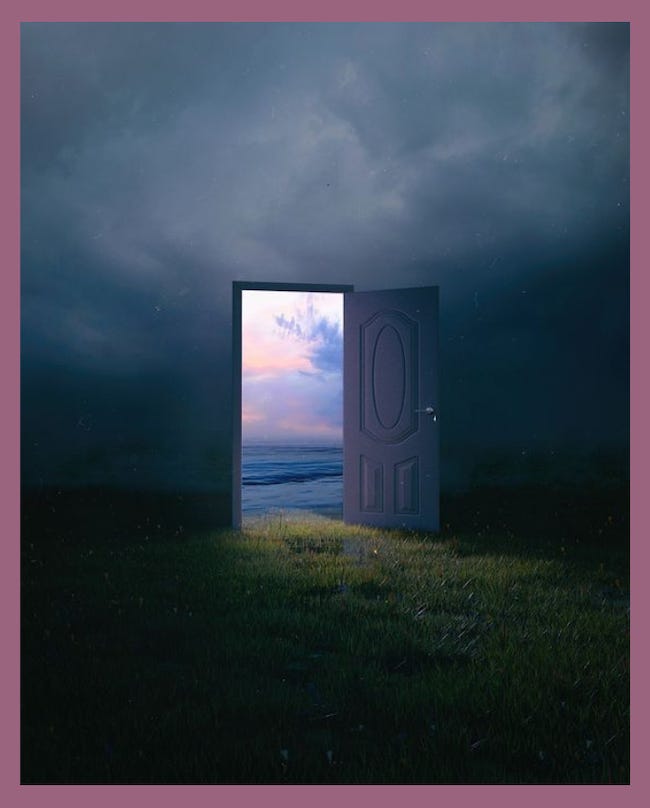
I’ve always been fascinated by the idea of liminal spaces - the long, dark hallways of life that can be eerie, uncomfortable and disorienting.
And right now, it feels like we’re living through a collective liminal moment.
If you’ve never heard of the concept (or maybe have always been intrigued 👀), “liminality” describes the unseen, in-between phase when old systems and beliefs have dissolved - but new ones haven’t formed yet.
Anthropologist, Arnold van Gennep, first introduced it in the early 1900s to describe the middle stage of major life transitions - like entering adulthood, having a family and even death. Since then, it’s become a cornerstone concept in psychology, creativity, and even anthropology, helping us understand everything from social movements to creative breakthroughs.
I can bet you all have felt it before - on a micro or macro scale: That moment when you can no longer go backwards, but you can’t yet see what’s ahead.
The problem is: Up until recently, we humans saw liminal spaces as sacred.
Instead of thinking we had done something wrong during the quiet and ambiguous - and rushing to fill it with action - we sat in the unknown. We didn’t push for immediate answers. We trusted that the emptiness was actually the precipice of transformation.
Our Deep Dive this week explored the science behind the Creative Process, revealing something stark about our world today: In our rush to act, we get stuck in Phase 1, Preparation.
These days, we fill the liminal with noise, consuming information as a form of protection. We scroll endlessly through our social feeds, binge content or “research” (guilty 😵💫) instead of leaning in to the creative pause.
But, as many of you learned, we know scientifically that the next phase of the Creative Process, the Incubation Phase - creativity’s liminal space - is quite literally where the “magic” happens.
Our brain seems like it’s “doing nothing” on the surface, but the Default Mode Network is hard at work connecting dots, synthesizing disparate ideas, and forming associations that conscious effort alone can’t do. Even more than that - research shows that our brain is actually operating at its fastest speed, gamma wavelengths, right before an Aha! Moment occurs.
To me, as a Creative Health Scientist, that’s about as poetic as our creative brain could get 🥹. As I wrote on Thursday:
At the end of the day, Creative Health isn’t about doing more - it’s about honoring the entirety of the cycle. So, no matter where you are in life, remember this:
The unseen phases - the pauses, the incubation, the quiet that seems like stagnation on the surface - are actually the moments where transformation is taking shape.
It’s our bridge to beauty, meaning, and the kind of breakthroughs that completely reshape everything…even if you can’t see it yet 🫶🏽
Scientifically, emotionally and energetically: The space of darkness and uncertainty doesn’t mean you’re regressing. In fact, it often means you’re on the threshold of creative transformation.
So, let’s allow ourselves to lean into it a bit more. To sit with the unknown. And finally, give our brain and life permission to incubate.
The unseen is where the work - and the magic - really begins.
From my brain to yours,
Katina, Creative Health Scientist & Daydreamers’ Co-founder + Chief Science Officer

THERE’S HOPE IN THE DARK 🌒
“Hope is not a lottery ticket you can sit on the sofa and clutch, feeling lucky. It is an axe you break down doors with in an emergency. Hope should shove you out the door, because it will take everything you have to steer the future away from endless war, from the annihilation of the earth’s treasures and the grinding down of the poor and marginal. To hope is to give yourself to the future - and that commitment to the future is what makes the present inhabitable.”
→ From one of my absolute favorite books that shows how the liminal spaces of life, social movements, and personal creativity can feel navigable - even in the midst of uncertainty. Written as a protest to the Iraq War: Hope in the Dark by Rebecca Solnit
IF YOU NEED AN ESCAPE: ENTER DREAMCORE 🪐
Dreamcore is a surrealist, Internet aesthetic that was first developed in 2018 on Tumblr that’s surged in popularity during our collective liminal phase. I think that’s because it reflects exactly how we feel today: caught between analog and digital, nostalgic for a simpler past, and living in constant transition - socially, ecologically, technologically. It’s Daydreamers (and frankly our collective unconscious) visualized.
→ Browse through Aesthetics Wiki here. Want to nerd out even more? Read this paper on Dreamcore Art and Liminal Spaces in our world today
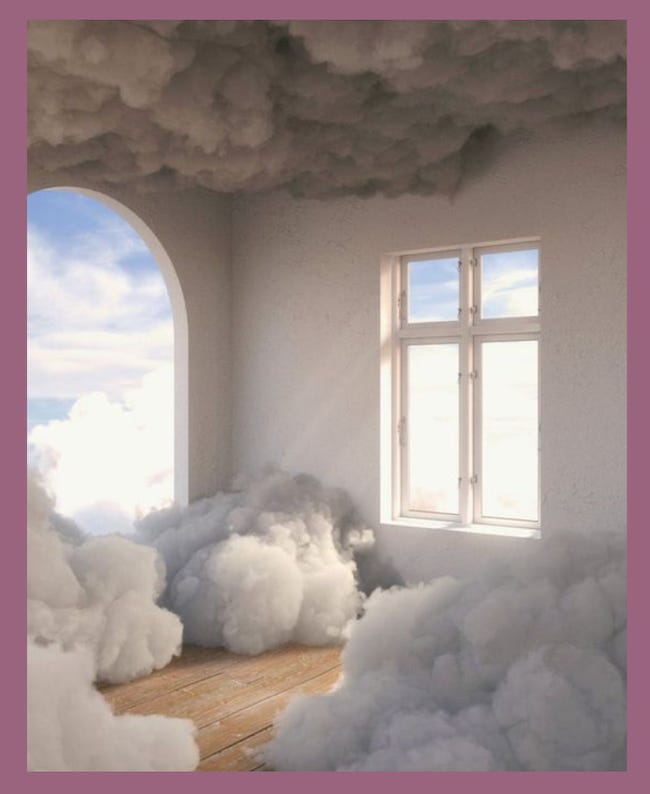

A PEEK INTO THE “COLLECTIVE UNCONSCIOUS”
Whenever I’m navigating liminal spaces, I look for collective symbols and archetypes - anchors that guide me through uncertainty and darkness.
These come from a concept in Jungian psychology called the Collective Unconscious: a layer of the psyche shared by all humans, containing universal symbols, archetypes, and emotional patterns that appear across cultures and eras. Think - doorways, shadows, hands, death, rebirth, light.
At Daydreamers, and in my own Creative Health practice, we use his exercise - Active Imagination to bring structure to our own creative process. Because, when we see these archetypes in physical form, our brain begins connecting them in new ways - creative ideas, stories and solutions emerge out of our shared visual language.
Spend some time exploring Jung’s archive and see which collective symbols speak to you. It’s a rarely discussed, but profound form of Creative Health.
REACH 15K+ CREATIVES, THINKERS AND LEADERS
If you’re building tools and ideas that help our community think more expansively, create more freely, and live more intentionally, and you’re interested in advertising with us, send an email over to ddhq@daydreamers.co with the subject “CreativeRx”

This newsletter today is brought to you by Daydreamers: The first + only platform that turns your creativity into a consistent, science-backed habit. Creativity isn’t a luxury; it’s for all of us. And, it’s never been more important for everyone to exercise it.
My goodness-- the piece on Liminal Spaces switched a light in me. It's so insightful to hear that it's actually beneficial to sit with these spaces and enjoy it, rather than them being something to get rid of as soon as possible. How did we become conditioned to perceive these sacred spaces as being meaningless and not functional when they are so integral to our ideas and their executions, whether it be intellectual or creative? I think this really ties into the concept of valuing the journey, and not just the destination-- not just the places on the journey where you're moving, but also where you're sitting still.